
Okay so I want to start with something a bit uncomfortable.
Most women who walk into my clinic have already tried losing weight. Multiple times. And when I ask them what went wrong, it’s almost never about effort. They were trying really hard sometimes too hard, honestly. The problem was usually the plan itself. Either it was too strict, or it was designed for someone completely different, or it just didn’t match how real life works.
So before I hand you a diet chart, I want to talk a little about why things go wrong. Because if you understand that part, the chart actually makes sense. And you’re a lot more likely to stick to it.
Women’s bodies are not small versions of men’s bodies
I know that sounds obvious. But most diet advice out there the calorie counts, the macro splits, the “just eat less and move more” crowd is built on research done mostly on men. And female physiology is genuinely different in ways that matter for weight loss.
Hormones are the big one. Estrogen, progesterone, cortisol, insulin these all fluctuate throughout your cycle, and they all influence how your body stores fat, how hungry you feel, and how much water you retain. In the week before your period, cravings go up and energy tends to dip. After ovulation, your metabolism actually runs slightly faster. During perimenopause, fat starts redistributing toward the abdomen even without eating more.
None of this is an excuse. It’s just context. And context changes what a smart diet plan looks like.
The calorie question let’s just deal with it
I know some people hate talking about calories. But I’d rather be honest with you than vague.
For most women, losing fat steadily and sustainably means eating somewhere around 1,200 to 1,500 calories a day depending on your height, current weight, how active you are, and your age. That creates a mild enough deficit to burn fat without sending your body into conservation mode.
Going below 1,200 is where things start breaking down. I’ve had patients eating 800–900 calories a day who weren’t losing weight, because their metabolism had slowed down to match their intake. Their hair was falling out, they were exhausted, and they couldn’t understand why the scale wasn’t moving. The body is smarter than the plan sometimes.
You don’t need to obsessively count every calorie forever. But understanding roughly what you’re eating in the beginning — even just for two or three weeks is genuinely useful. It’s almost always eye-opening.
Protein is probably the most important thing you’re under-eating
If I had to pick one change that makes the biggest difference for the women I work with, it’s eating more protein.
Most Indian women I see are getting maybe 30–40 grams of protein a day. The actual target for weight loss is more like 60–90 grams, depending on your body weight. That gap is huge.
Why does it matter so much? A few reasons. Protein keeps you full longer than carbs or fat it genuinely reduces how hungry you feel throughout the day. It also protects your muscle while you’re eating in a deficit, which matters because losing muscle slows your metabolism. And it supports the hormones involved in hunger and satiety.
Dal once a day isn’t enough. Eggs, paneer, curd, rajma, chana, tofu, chicken, fish you need to be stacking these across multiple meals, not treating protein as an afterthought.
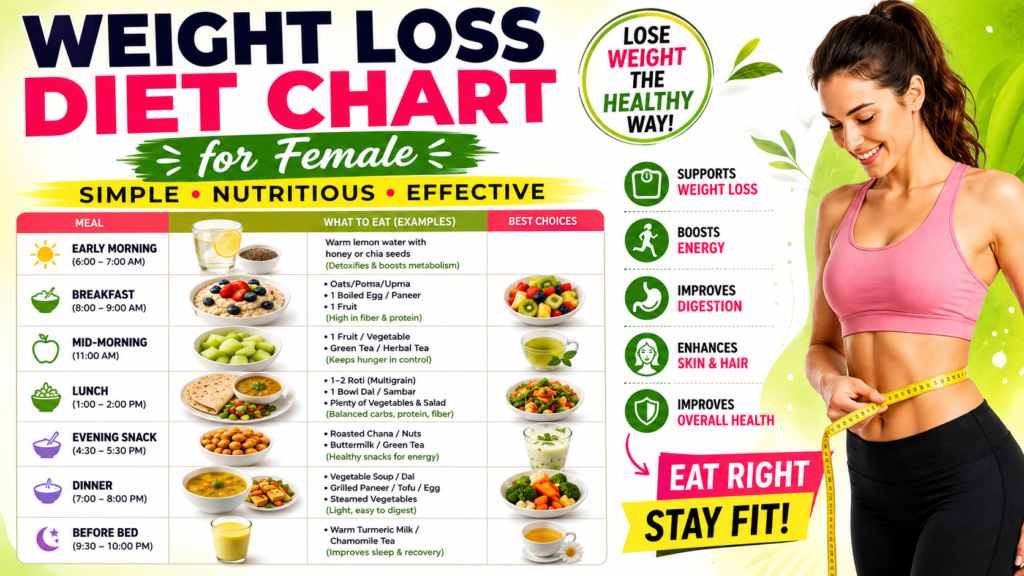
The actual 7-day diet chart
This is built around roughly 1,300–1,400 calories, real Indian food, and enough protein to actually make a difference. Adjust portions based on your hunger this is a template, not a test.
Day 1
Morning, before anything else: a glass of warm water. Add lemon if you like it, skip it if you don’t. Eat 5–6 soaked almonds.
Breakfast: 2 moong dal chillas with mint chutney, and a small bowl of curd on the side.
Around 11am when you get hungry: 1 guava, or whatever fruit is in season. Keep it simple.
Lunch: 1 cup cooked brown rice, a bowl of dal, one sabzi made with minimal oil, and some sliced cucumber or a small salad.
Evening: Green tea or black tea without sugar, and a small fistful of roasted makhana or chana.
Dinner: 2 whole wheat rotis, a small bowl of palak paneer or any dal-based curry, and some raita or curd.
Day 2
Morning: Jeera water — boil a teaspoon of jeera in two cups of water, let it cool a bit, drink it. Old school but it works for digestion.
Breakfast: Poha — the kind loaded with vegetables, not just the plain flattened rice version. Add some sprouted moong on top if you have it.
Mid-morning: An orange, or a small bowl of pomegranate.
Lunch: 2 jowar rotis with rajma masala and a side salad. If jowar rotis feel too dry at first, mix a little wheat flour in until you get used to them.
Evening: A glass of chaas (plain, no salt bombs), and 10–12 roasted chana.
Dinner: 100 grams of grilled or baked fish, or tofu if you’re vegetarian, with stir-fried vegetables and 1 roti.
Day 3
Morning: Warm water with a tiny pinch of turmeric and grated ginger.
Breakfast: Oats upma — cook it with lots of vegetables. Zucchini, carrots, peas, whatever you have. It sounds boring but it’s actually filling and keeps you going till lunch.
Mid-morning: A pear, or a small bowl of watermelon.
Lunch: Brown rice khichdi with a small bowl of low-fat dahi. Khichdi gets underrated — it’s a complete protein when the dal and rice are eaten together.
Evening: A mix of seeds — pumpkin, sunflower, flax. A small handful, not a bowlful.
Dinner: 2 rotis with methi dal and mixed vegetables.
Day 4
Morning: Soak a teaspoon of chia seeds in a glass of water overnight, drink it in the morning.
Breakfast: 2 idlis with sambar. Keep the coconut chutney small — it’s calorie-dense.
Mid-morning: 1 apple.
Lunch: Mixed sprout chaat — this is underrated as a lunch. Sprouts, chopped onion, tomato, cucumber, lemon, a bit of chaat masala. Easy to make, high protein, very filling. Add 1 roti if you’re still hungry.
Evening: Green tea, and 2 multigrain crackers with a thin spread of peanut butter.
Dinner: Egg bhurji made with 2 eggs, or paneer bhurji with 2 rotis and salad.
Day 5
Morning: Warm water with 1 teaspoon of diluted apple cider vinegar. Always dilute — never drink it straight.
Breakfast: 2 besan chillas with a small bowl of curd.
Mid-morning: Muskmelon or papaya.
Lunch: A grain bowl — brown rice or quinoa, roasted vegetables, 50 grams of paneer or a boiled egg, olive oil and lemon dressing. Takes 15 minutes to put together.
Evening: Homemade vegetable soup. The packet ones are mostly sodium. Make a simple one with whatever vegetables you have.
Dinner: 1 roti, a bowl of thin dal, and a boiled egg or 50g paneer.
Day 6
Morning: Lemon water.
Breakfast: Thick curd or Greek yoghurt, a tablespoon of flaxseeds, a few walnuts, and whatever fruit you have — berries, pomegranate, banana.
Mid-morning: Coconut water.
Lunch: 2 rotis with chana masala and a cucumber-onion raita.
Evening: Roasted makhana or a small banana.
Dinner: Dal soup, 1 roti, salad. Light dinner on day 6 because you’ve eaten well all week.
Day 7
Sunday. Please eat something you enjoy. Cook at home, keep it reasonable, but don’t spend Sunday miserable eating plain dal and feeling like you’re punishing yourself. That’s not sustainable and it’s not healthy either. One relaxed meal doesn’t ruin anything.
Things I genuinely see going wrong
Skipping meals. I know it feels like eating less must mean losing more. But skipping breakfast especially tends to backfire — blood sugar crashes by mid-morning, and you end up eating more at lunch and snacking more in the evening than you would have if you’d just eaten something in the morning.
Eating “healthy” foods in unlimited amounts. Nuts are healthy. Ghee is fine in small amounts. Dates are better than processed sugar. But they are all calorie-dense, and “healthy” doesn’t mean “eat as much as you want.” I’ve seen women eat 200 grams of mixed nuts a day wondering why they weren’t losing weight. That’s over 1,000 calories right there.
Drinking calories without noticing. Packaged juices, sugary chai three times a day, flavoured yoghurt, coconut water with added sugar — these add up faster than most people realise. Drink plain water, plain chai with minimal sugar, plain chaas. The calories you drink don’t fill you up the same way food does.
Weighing yourself every single day. Weight fluctuates 1 to 2 kilos day to day based on water retention, what you ate, digestion, your cycle. Weighing daily just causes panic. Weigh once a week, same time, same conditions.
Giving up after one bad day. One heavy meal, one social dinner, one festival — none of these matter in the context of weeks and months of consistent eating. The women I’ve seen lose weight and keep it off weren’t perfect. They just didn’t let one bad day become a bad week.
If you have PCOS, thyroid issues, or are going through perimenopause
A standard calorie-restriction plan often doesn’t work as well for these conditions, and it’s not your fault when it doesn’t.
PCOS involves insulin resistance in most cases, which means your body handles carbohydrates differently. Lower glycemic foods, more protein, more fibre, and strength training alongside diet makes a significantly bigger difference than just cutting calories.
Hypothyroidism slows metabolism, so the usual calorie math doesn’t apply the same way. Selenium-rich foods like eggs and sunflower seeds, adequate iodine, and eating enough overall (not too little) supports thyroid function. And please, take your medication consistently — diet supports it, it doesn’t replace it.
Perimenopause is honestly one of the most frustrating periods for women trying to manage weight, because the usual things stop working as well. Increasing protein significantly, doing some form of resistance training, and focusing on sleep and stress management often matter more at this stage than further calorie restriction.
If any of these apply to you, I’d strongly suggest working with a dietitian individually rather than following a general plan.
How fast will you actually see results?
Honestly? The first week you might drop 1–2 kilos — but that’s mostly water and glycogen, not fat. Real fat loss after that is slower. Half a kilo to a kilo a week is genuinely good progress.
What usually happens around week two or three is: energy improves, bloating reduces, sleep gets better, digestion feels more regular. The scale might not have moved much. But those signs mean something is shifting. Keep going.
The women I’ve worked with over the years who’ve actually kept the weight off — and I’ve seen quite a few by now — they weren’t the strictest dieters. They were the most consistent ones. They built a way of eating that felt normal enough to maintain. That’s the whole goal here.
Also Read:
7 Foods Making Your Thyroid Worse (Without You Realizing It)
How to Lose Belly Fat Without Going to the Gym
Best Fruits for PCOS Weight Loss
Vegetarian Diet for PCOS Weight Loss – Dt. Ritika Dua (Complete Guide for Women)
Thyroid Diet Plan for Working Women: Eat Right, Lose Weight Naturally
Hypothyroidism Diet Plan for Weight Loss: What Actually Helps in Real Life